
UAE businesses should invest in electronic signature solutions because they cut document turnaround from days to minutes, are fully legal under Federal Decree-Law No. 46 of 2021, reduce document costs by up to 80%, strengthen fraud protection through biometric capture, and meet compliance needs in banking, healthcare, and government sectors across the GCC.
Why Electronic Signature Adoption Is Accelerating Across the UAE
The UAE’s push toward a paperless economy has moved from policy ambition to daily business practice. Federal and emirate-level government entities now process the majority of transactions digitally, and private-sector organizations — from banks to hospitals to retail chains — are following suit to stay compliant, competitive, and efficient.
This shift is not cosmetic. The Middle East & Africa digital signature market was valued at roughly USD 0.83 billion in 2025 and is projected to reach USD 1.17 billion in 2026, and UAE banking, healthcare, and government digitalization initiatives are cited as the primary growth drivers across Gulf Cooperation Council markets. For procurement teams and IT managers, the question in 2026 is no longer whether to adopt electronic signature solutions — it’s which hardware and workflow will deliver the strongest return.
Below are ten evidence-based reasons UAE organizations are investing in electronic signature solutions, followed by the legal, compliance, and industry context you need to make the business case internally.
1. Electronic Signatures Are Fully Legal and Enforceable in the UAE
Electronic signatures are recognized and enforceable under Federal Decree-Law No. 46 of 2021 on Electronic Transactions and Trust Services (the ETTS Law), supported by Cabinet Resolution No. 28 of 2023. The UAE Evidence Law (Federal Law No. 35 of 2022) reinforces this by confirming that properly executed electronic signatures carry the same evidential weight in court as a handwritten signature.
UAE courts have already tested this in practice. In Dubai Court of Cassation Case No. 131 of 2022, the court ruled that electronic documents and signatures are admissible provided they meet the legal criteria for identity verification and document integrity. A similar position was taken in Abu Dhabi Court of Appeal Case No. 529 of 2021. Free zones including the DIFC (DIFC Law No. 2 of 2017) and ADGM (Electronic Transactions Regulations 2021) apply closely aligned frameworks, and both allow cross-border recognition of signatures created outside their jurisdiction.
The ETTS Law does exclude a small set of transactions — wills, marriage and family-status documents, and certain real estate transfers and long-term leases — which still require wet-ink signatures. For virtually every other commercial, HR, financial, and administrative document, electronic signatures are legally sound.
2. Stronger Security Than Paper or Basic Digital Signatures
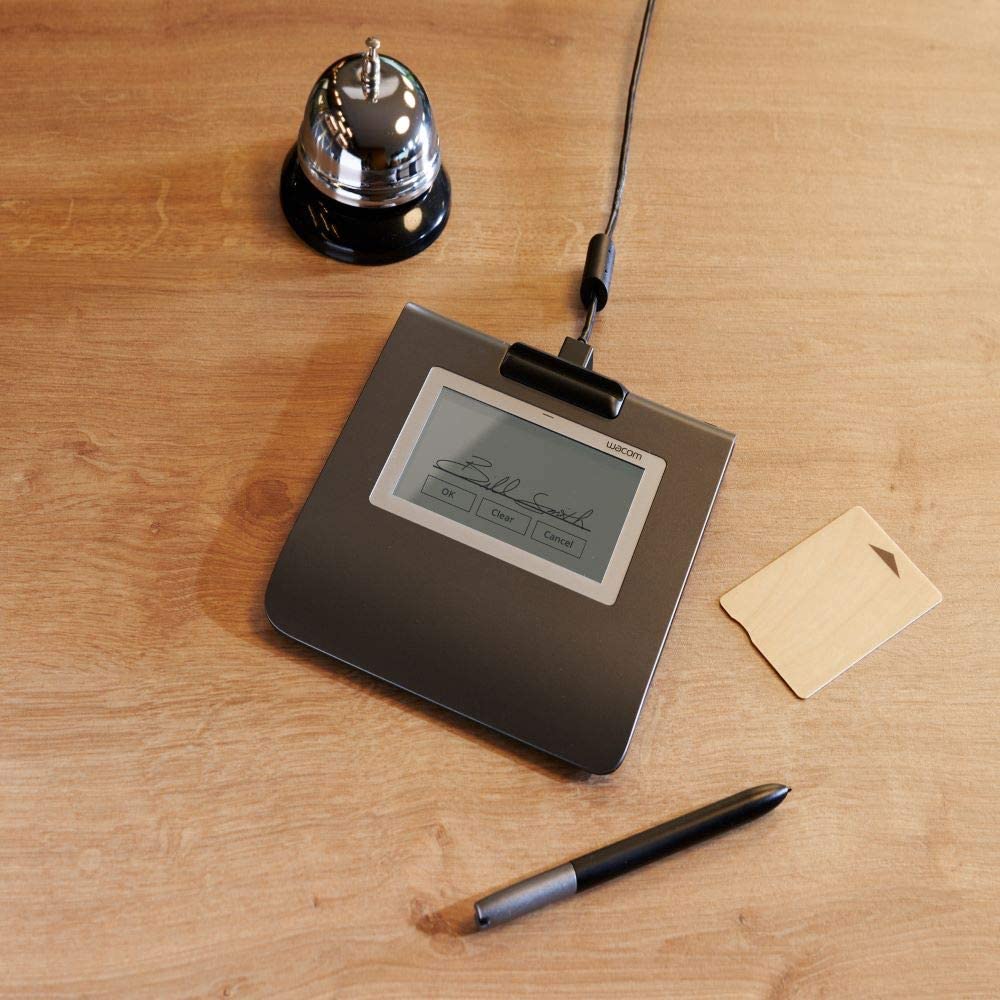
Signature pads and displays built on Wacom’s electromagnetic resonance (EMR) technology capture far more than an image of a signature. They record pressure, speed, stroke order, pen angle, and timing — biometric data that is extremely difficult to forge and that creates a verifiable audit trail. Because the sensor sits beneath the display glass rather than on the signing surface, the capture technology is not degraded by scratches or daily wear, unlike resistive touchscreens.
This biometric layer matters for dispute resolution. A scanned wet-ink signature or a typed name provides little more than a static image; a Wacom-based capture provides forensic detail that a document management system can log, encrypt, and present as evidence if a signature is ever challenged.
For a deeper technical look at how forensic capture works, read our related article on the benefits of biometric signature verification.
3. Dramatic Reduction in Document Turnaround Time
Paper-based approval chains routinely take two to five business days once printing, courier delivery, physical signing, and re-scanning are factored in. Electronic Signature Solutions workflows compress that into minutes, whether the signer is in the same branch or across the GCC. For sectors like real estate, insurance, and banking — where deal velocity directly affects revenue — this is often the single biggest driver of the purchase decision.
4. Measurable Cost Savings on Paper, Storage, and Courier Spend
Eliminating printing, physical archiving, courier fees, and manual re-keying of data reduces per-document processing costs substantially. Organizations that shift high-volume paper processes — loan applications, HR onboarding, patient intake — to electronic signature capture typically see the sharpest savings, since these are the workflows with the highest document volume and the most manual handling per transaction.
| Cost Factor | Paper-Based Process | Electronic Signature Process |
| Printing & materials | Recurring cost per document | Eliminated |
| Courier / physical delivery | 1–3 days, per-shipment fee | Instant, no courier cost |
| Physical storage | Ongoing archive/warehouse cost | Digital storage only |
| Manual data re-entry | High error risk, labor cost | Automated field capture |
| Signature turnaround | 2–5 business days typical | Minutes to same-day |
5. Built for Multi-Industry Deployment
A single signature capture platform can support banking account opening, hospital patient consent forms, school enrollment, and government service counters without redesigning the underlying workflow. This flexibility is a major reason procurement teams standardize on one signature-hardware vendor across departments rather than buying disparate point solutions.
See how the same technology applies in healthcare in our guide to electronic signature tablets for medical records, and in banking and finance in our article on the electronic handwriting signature system in the finance sector.
6. Hardware Options for Every Environment
Wacom’s signature capture portfolio spans compact signature pads for counters and kiosks (the STU series), full signature displays that show the document on-screen during signing (the DTU and DTK series), and mobile-ready capture for field agents. This range lets IT teams match device size, durability, and price point to the specific branch, ward, or classroom it will serve, rather than forcing every location onto the same hardware.
7. Compatibility With Existing Document and Business Systems
Signature capture hardware from established vendors integrates with common document management systems, core banking platforms, electronic health record systems, and PDF workflows through published SDKs and pre-built connectors. This avoids the integration risk of building signature capture from scratch, and it means IT teams can roll out new signing points without re-architecting existing software.
8. High-Fidelity Signature Capture and Signing Experience
Signature displays that render the actual document on the pad’s own screen — rather than asking the signer to look up at a separate monitor — produce a signing experience much closer to signing on paper. This reduces signer confusion, increases signature consistency, and improves the quality of the biometric data captured, which in turn strengthens the evidentiary value of the record.
9. Compliance Alignment Across Regulated Sectors
Banking, healthcare, insurance, and government entities operate under sector-specific data protection and audit requirements in addition to the general electronic transactions framework. Signature capture hardware that supports encrypted data transmission, tamper-evident audit trails, and integration with identity verification systems helps compliance and risk teams meet these obligations without adding manual verification steps to every transaction.
10. Future-Proofing Against Evolving Identity and Authentication Standards
The UAE’s electronic transactions framework distinguishes between standard electronic signatures, Advanced Electronic Signatures (AES), and Qualified Electronic Signatures (QES) — the last requiring issuance by a TDRA-licensed Trust Service Provider. Organizations investing in signature capture hardware today should choose platforms capable of supporting AES and QES workflows and integrating with national identity schemes such as UAE PASS, so the investment continues to meet regulatory requirements as they tighten.
Electronic Signatures vs. Traditional Wet-Ink Signatures: A Side-by-Side Comparison
| Criteria | Wet-Ink Signature | Wacom Electronic Signature Capture |
| Legal validity in onshore UAE | Valid, but standalone evidentiary weight | Valid under Federal Decree-Law No. 46/2021, with biometric audit trail |
| Turnaround time | Days (print, courier, file) | Minutes, same-visit or remote |
| Forgery resistance | Low — visual comparison only | High — pressure, speed, stroke biometrics captured |
| Storage & retrieval | Physical archive, slow retrieval | Instant digital search and retrieval |
| Environmental impact | High paper and ink usage | Minimal — supports paperless targets |
| Integration with digital systems | Requires manual re-entry | Direct integration with DMS, EHR, core banking |
How to Decide If Your Organization Is Ready to Invest
Use the checklist below to gauge readiness before requesting a quote:
- You process more than roughly 50 signed documents per week per branch or department.
- Your organization has a stated paperless or digital transformation target.
- Compliance or legal teams have flagged signature audit trails as a risk area.
- You operate in banking, healthcare, insurance, government, or education — sectors with high document-signing volume.
- Remote or multi-branch signing currently requires courier or in-person visits.
If three or more of these apply, the return on investment case for electronic signature hardware is typically strong within the first 12 months of deployment.
Pros and Cons of Investing in Electronic Signature Hardware
Pros: faster turnaround, lower long-run cost per document, stronger fraud protection, regulatory alignment, better customer/patient/citizen experience, environmental benefits.
Cons: upfront hardware and integration cost, staff training required, and a small subset of legal document types (wills, certain real-estate transfers, marriage/family-status matters) still require wet-ink signatures under UAE law.
Frequently Asked Questions
Are electronic signatures legally binding in the UAE?
Yes. Electronic signatures are legally recognized and enforceable under Federal Decree-Law No. 46 of 2021 on Electronic Transactions and Trust Services, and the UAE Evidence Law confirms they carry the same evidential weight as handwritten signatures when they meet the required identity-verification and integrity standards.
What is the difference between an electronic signature and a digital signature?
An electronic signature is any electronic means of indicating intent to sign — including a biometric signature captured on a Wacom pad. A digital signature specifically uses cryptographic techniques (such as a certificate from a licensed Trust Service Provider) to secure the document. All digital signatures are electronic signatures, but not all electronic signatures use digital signature cryptography.
Which UAE law governs electronic signatures?
The primary legislation is Federal Decree-Law No. 46 of 2021 on Electronic Transactions and Trust Services, supported by Cabinet Resolution No. 28 of 2023. The DIFC and ADGM free zones apply their own closely aligned frameworks — DIFC Law No. 2 of 2017 and the ADGM Electronic Transactions Regulations 2021, respectively.
Are there documents that still require a wet-ink signature in the UAE?
Yes. Personal-status matters such as marriage, divorce, and wills, along with certain real estate sale, disposition, and long-term lease transactions, are excluded from the electronic transactions framework and still require traditional signatures.
How does a Wacom signature pad differ from simply signing on a touchscreen?
Wacom’s EMR technology captures pressure, pen angle, stroke speed, and timing data beneath the display glass, producing forensic-level biometric detail. A standard capacitive touchscreen typically only records the shape of the signature, offering far less evidence in the event of a dispute.
What is the ROI timeline for adopting electronic signature hardware?
Organizations with high document volumes — banks, hospitals, insurers — commonly see a return within 6 to 12 months, driven by reduced printing, courier, and storage costs plus faster deal or case closure.
Can electronic signature solutions integrate with our existing banking or hospital software?
Yes. Established signature-hardware vendors provide SDKs and pre-built connectors for common document management systems, electronic health record platforms, and core banking software, allowing integration without rebuilding existing workflows.
Is electronic signature technology secure enough for financial transactions?
Yes, when paired with encrypted data transmission and biometric capture. Many UAE and GCC financial institutions already use signature pads for account opening, loan documentation, and teller transactions under the ETTS Law framework.
What industries in the UAE are adopting electronic signature solutions fastest?
Banking and financial services, healthcare, government services, and education are the leading adopters, driven by high document volume, compliance requirements, and national paperless-government initiatives.
Do electronic signatures work across GCC borders?
Generally yes for commercial purposes, since the UAE, Saudi Arabia, and other GCC states have each adopted electronic transactions laws broadly aligned with the UNCITRAL Model Law. However, cross-border enforceability should be confirmed for high-value or multi-jurisdictional agreements.
What is a Qualified Electronic Signature (QES) and do I need one?
A QES is the highest tier of electronic signature under UAE law, issued by a TDRA-licensed Trust Service Provider, and carries the strongest legal presumption of validity. Most day-to-day commercial documents do not require QES, but high-value contracts, government filings, and regulated financial transactions increasingly do.
How much does it cost to deploy electronic signature pads across multiple branches?
Costs scale with device type (compact signature pad versus full signature display) and integration complexity. Request a tailored quote based on branch count, document volume, and existing software so the cost can be weighed against projected paper, courier, and storage savings.
Conclusion
Electronic signature adoption in the UAE is no longer an early-mover experiment — it is a compliance-aligned, legally tested, and financially justified upgrade that banking, healthcare, government, and education organizations across the country are already making. The combination of Federal Decree-Law No. 46 of 2021, supportive court precedent, and rising GCC-wide digital transformation targets means the legal and regulatory risk of adopting electronic signature hardware is low, while the operational upside — faster turnaround, lower cost per document, and stronger fraud protection — is well documented.
For procurement and IT teams comparing options, the decision usually comes down to matching the right hardware (compact pad, full signature display, or mobile capture) to each branch, ward, or counter, and confirming the vendor’s integration support for your existing systems.
Ready to see the right Wacom signature solution for your organization? Contact wacomme.ae, Wacom’s authorized partner in the UAE, for a tailored demo and quote.
Wacom Signature Display technology is embedded under the display, and not on the signing surface, it delivers outstanding longevity. Unlike resistive technologies, Wacom products are not impacted by wear or scratches to the screen surface. Our patented EMR technology does not require batteries to power the pen and no wires to transmit signals, so they are maintenance-free and will not fail if the tether is damaged. In addition to a robust design that provides years of service, our signature pads capture advanced biometric data for more accurate verification. The Wacom Signature Display data or Innovative electronic Signature Device can be transmitted securely with modern encryption capabilities. They also feature an ergonomic design that is comfortable to use and looks great on a counter, kiosk, or desk
Here are ten reasons why investing in Wacom Signature Solutions makes sense:
- Enhanced Security: By replacing traditional paper signatures with digital signatures, Wacom Signature Solutions help protect documents from forgery and create a secure audit trail.
- Paperless Workflow: Wacom Signature Solutions allow businesses to go fully digital, eliminating paper-based documents and streamlining workflows.
- Improved Efficiency: With digital signatures, documents can be signed in real-time, reducing signing times and enabling faster turnaround on important business processes.
- Cost-Effective: Eliminating the need for paper-based signatures and related tasks such as printing, scanning, and storing documents can save businesses money in the long run.
- Flexible Deployment Options: Wacom Signature Solutions can be implemented in various industries, including retail, healthcare, government, and finance, and can be customized to fit specific business needs.
- Versatile Hardware Options: Wacom offers a range of signature capture devices that can be utilized in various environments like desktops, mobile devices, or kiosks.
- Compatibility: Wacom Signature Solutions integrate with most popular operating systems, applications, and document management systems.
- High-Quality Signature Capture: Wacom’s signature capture technology delivers high-resolution images of signatures with excellent accuracy, providing a more natural and fluid signing experience.
- Compliance: Wacom’s signature solutions comply with regulatory standards such as eIDAS, HIPAA, PCI-DSS, and ESIGN, ensuring adherence to industry-specific regulations and compliance mandates.
- Future-Proofing: With emerging technologies like blockchain, Wacom Signature Solutions offer versatility by supporting advanced authentication technologies. It is a seamless experience making it easy to adopt modern and future identity verification protocols.
Overall, these reasons highlight how Wacom Signature Solutions can help businesses reduce costs, increase productivity, enhance security and compliance, and improve the customer experience in various industries. These benefits can lead to a positive return on investment while future-proofing against the evolving technological landscape.