
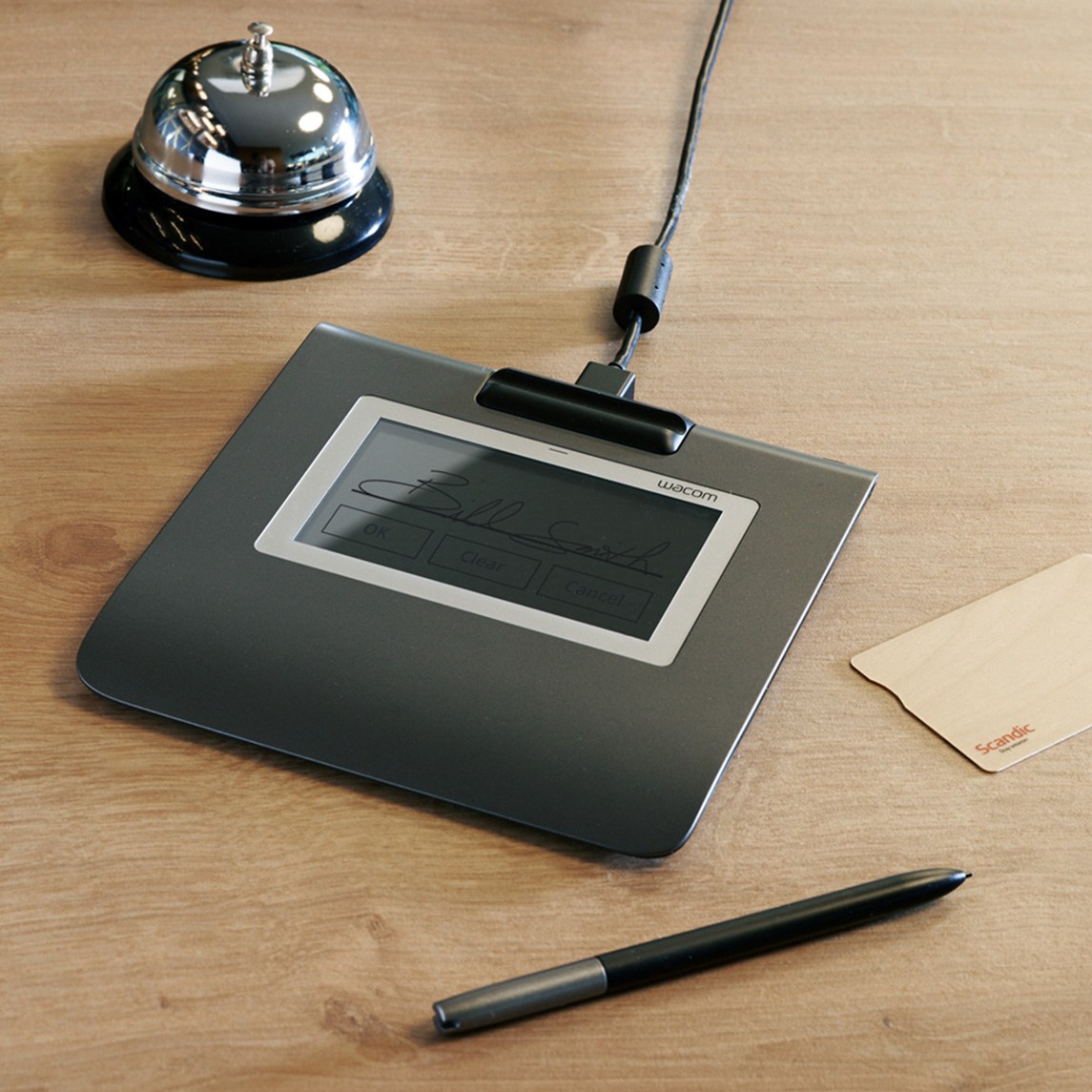
Businesses across Dubai and the Middle East are adopting electronic signature pads to align with the Dubai Paperless Strategy, cut document costs by up to 60%, and meet legal requirements under Federal Decree-Law No. 46 of 2021 — with compact pads suited to SMEs and retail, and full signature displays better matched to contracts and enterprise agreements.
Dubai’s Paperless Push Has Changed What ‘Normal’ Looks Like for Business
The Dubai government has already eliminated paper from its own internal and customer-facing services, and it built the legal, platform, and cultural infrastructure — UAE Pass digital identity, the DubaiNow services app, and the broader Dubai Paperless Strategy — to make that shift possible at national scale. For private businesses operating in Dubai and across the Middle East, this has quietly reset the baseline: interacting with government portals, banks, and increasingly larger corporate clients now assumes a business can produce and receive signed documents digitally, not just accept them.
For SMEs and mid-sized enterprises specifically, this creates both a compliance expectation and a competitive opportunity. Businesses that already sign contracts, delivery notes, HR forms, and service agreements electronically move faster in vendor onboarding and client contracting than those still relying on printed paperwork — and they do so on a legal footing that has been tested in UAE courts.
Why Electronic Signature Pads Specifically — Not Just Software
Many businesses start their paperless journey with software-only e-signature tools (typed names, click-to-sign checkboxes). These work for low-risk documents but offer limited defense if a signature is disputed, since they capture no biometric information about how the signature was made.
A physical signature pad or display adds a hardware layer that captures the handwritten signature itself — pressure, stroke speed, and timing — producing a record closer in spirit to a wet-ink signature while remaining fully digital. For businesses handling contracts, delivery acknowledgments, or customer agreements with real dispute risk, this hardware layer is a meaningful upgrade over software-only signing.
Matching Device Type to Business Size and Document Volume
| Business Profile | Recommended Device | Typical Use Case |
| Retail / F&B outlet | Compact monochrome signature pad | Receipt acknowledgment, delivery confirmation |
| Professional services / SME office | Compact or color signature pad | Service agreements, invoices, HR forms |
| Real estate / insurance brokerage | Signature display | Multi-page contracts, policy documents |
| Logistics / distribution | Portable signature pad | Proof-of-delivery, driver handoff forms |
| Large enterprise / multi-branch operation | Mixed fleet (pads + displays by function) | Standardized signing across departments and locations |
The Business Case: Cost, Speed, and Client Experience
Industry analysis of paperless adoption in Dubai points to processing time reductions of up to 70% and document cost reductions of up to 60% for businesses that integrate compliant electronic signature tools with their existing workflows and ERP or document management systems. For a small or mid-sized business, this typically shows up as: fewer printing and courier expenses, faster contract turnaround with clients and vendors, and reduced administrative time spent chasing physical signatures across branches or with remote clients.
Common adoption barrier: resistance from paper-reliant staff is the most frequently cited hurdle in Dubai paperless-transition case studies, not the technology itself. Vendor-led training and a phased rollout — starting with one document type, such as delivery notes or service agreements — consistently improve adoption rates.
Staying Compliant While Scaling Across the GCC
Businesses expanding beyond the UAE into Saudi Arabia, Qatar, or other GCC markets should note that each country has its own electronic transactions law, generally aligned with the UNCITRAL Model Law but not identical. Saudi Arabia’s Electronic Transactions Law and Qatar’s own digital government agenda both recognize electronic signatures for most commercial purposes, but cross-border agreements should be checked for jurisdiction-specific requirements before relying on a single signing process across all markets.
- Confirm which document types are excluded from electronic signature in each jurisdiction (commonly: wills, marriage/family matters, certain real estate transfers).
- Standardize on signature hardware with strong encryption and biometric capture so the same device fleet can support multiple country operations.
- Keep signed document archives accessible per each country’s data-retention expectations, even when hosted centrally.
Getting Started: A Practical Rollout Checklist for SMEs
- Identify your two or three highest-volume paper-signing document types (e.g., delivery notes, service agreements, HR onboarding forms).
- Choose a compact signature pad for quick, low-risk documents and reserve a signature display for anything multi-page or high-dispute-risk.
- Confirm integration with your existing invoicing, CRM, or document management software before purchasing hardware.
- Pilot with one department or branch for two to four weeks before a full rollout.
- Budget a short training session — most adoption resistance is unfamiliarity, not the hardware itself.
Pros and Cons for Dubai and Middle East Businesses
Pros: aligns with Dubai’s paperless business environment, faster contract and delivery turnaround, lower document-related costs, stronger fraud resistance than software-only e-signatures.
Cons: upfront hardware cost, staff training required, and a small number of document types across GCC jurisdictions still require wet-ink signatures.
Wacom Products for Electronic Signature
Wacom electronic solutions enable handwritten electronic signatures or Electronic Signing Solution,Digital Signatures within document workflows that require in-person interaction.
Pen Hardware
wacomme’s market-leading digital pen and Electronic Signature Pads Signature tablets products including signature tablets, pen displays and clipboards are the foundation for the most intuitive user experience with digital pen and ink.
Applications and Services
A combination of use case-specific apps, services and priority support enable so our technology partners to integrate advanced digital ink functionality into tailored document workflow solutions for businesses.
WILL™ Digital Ink Signature Pad
WILL™ (Wacom Ink Layer Language) is a technology framework incorporating unique algorithms and a file format for visualizing and storing digital ink data.
Frequently Asked Questions
Are electronic signature pads legally valid for businesses in Dubai?
Yes. Electronic signatures are recognized and enforceable under Federal Decree-Law No. 46 of 2021 on Electronic Transactions and Trust Services, and Dubai’s own government services have operated on a paperless, digitally signed basis since 2021.
What’s the difference between software e-signatures and a physical signature pad?
Software e-signatures (typed names, click-to-sign) work for low-risk documents but capture no biometric data. A signature pad captures the handwritten signature itself, including pressure and stroke speed, producing stronger evidentiary support if a signature is ever disputed.
How much can a small business save by switching to electronic signature pads?
Industry analysis of Dubai paperless adoption points to processing time reductions of up to 70% and document-related cost reductions of up to 60% when electronic signature tools are properly integrated with existing business systems.
Which electronic signature pad is best for a small retail business in Dubai?
A compact, monochrome signature pad is generally sufficient for retail acknowledgment forms and delivery confirmations, offering the best balance of cost and speed for high-volume, low-risk transactions.
Do electronic signatures work the same way across all GCC countries?
Most GCC countries, including Saudi Arabia and Qatar, recognize electronic signatures for commercial purposes under their own electronic transactions laws, generally aligned with the UNCITRAL Model Law, but specific requirements and excluded document types can vary by jurisdiction.
What documents still require a wet-ink signature in the UAE?
Personal-status matters such as marriage and wills, and certain real estate sale or long-term lease transactions, are excluded from the UAE’s electronic transactions framework and still require traditional signatures.
Can electronic signature pads integrate with UAE Pass or DubaiNow?
UAE Pass serves as the national digital identity and signing mechanism for many government-facing transactions; private-business signature pad deployments typically operate alongside, rather than directly through, UAE Pass, unless integrating specifically with a government service.
What’s the biggest obstacle businesses face when adopting electronic signatures?
Staff resistance to changing from paper-based habits is the most commonly cited barrier in Dubai paperless-transition case studies, more so than the technology itself. A phased rollout with proper training typically resolves this within weeks.
Do I need different signature hardware for contracts versus receipts?
It’s recommended. Compact signature pads suit quick, low-risk transactions like receipts and delivery confirmations, while signature displays — which show the full document on-screen — are better suited to contracts and multi-page agreements.
How long does it take to roll out electronic signature pads across a small business?
A typical phased rollout — starting with one high-volume document type in one department or branch — takes two to four weeks to validate before expanding company-wide.
Is it worth investing in signature pads if my business already uses e-signature software?
Yes, for documents with meaningful dispute risk. Adding hardware-based biometric signature capture strengthens the evidentiary record beyond what typed or click-to-sign software alone provides, without replacing your existing software workflow.
Where can Dubai and Middle East businesses buy Wacom electronic signature pads?
Wacomme is Wacom’s authorized signature-solutions partner in the UAE, serving Dubai, Abu Dhabi, and businesses across the wider Middle East and African region.
Conclusion
Dubai’s paperless government journey has reset expectations for every business operating in the emirate and, increasingly, across the wider Middle East. Electronic signature pads give SMEs and larger enterprises a straightforward, legally sound way to keep pace — combining the speed and cost savings of digital workflows with the biometric security that software-only e-signature tools can’t match.
The right starting point is rarely a company-wide rollout on day one. Identify your highest-volume paper document, match it to the right device category, and expand from there.
Ready to take the paperwork out of your Dubai or Middle East business? Contact Wacomme.ae Trading, Wacom’s authorized regional partner, for a signature pad recommendation tailored to your document volume and budget.